





AI stocks have experienced a pullback in recent months, primarily driven by investors questioning corporate profitability and whether the lofty valuations are justifiable. Adding to the volatility, recent calls from top industry executives for a coordinated development slowdown to address safety concerns have further shaken investor confidence. These anxieties, combined with high global borrowing costs, have triggered a market-wide rotation into defensive assets, cooling down the intense speculative euphoria that previously drove the sector to historic peaks.
While US industry leaders are not advocating a full pause on frontier AI development, markets are concerned that such safety considerations could slow the pace of advancement, which could in turn weigh on AI infrastructure demand.
However, we think any voluntary slowdown in AI development by a handful of industry leaders would be very limited in practice, and likely apply only to the riskiest, cutting-edge areas of AI, such as recursive self-improvement – a compounding feedback loop where an AI system assists in designing, coding or training its own next generation. Slowing frontier-model development does not necessarily mean lower spending or growth, and there is no suggestion today that AI CAPEX plans are being cut.
Furthermore, competition from open-weight models from China will pressure US AI labs to keep up with their training efforts to stay ahead. Otherwise, Chinese open-weight large language models (LLM) could eventually catch up in capabilities and erode the pricing power of US models.
Importantly, AI labs are already building safety monitoring into the compute stack, which could be a tailwind for compute spending over the coming years as labs integrate more safety-monitoring infrastructure.
Even without significant new development, AI models have now reached a sufficient level of capability for AI agents to be built on top of them to carry out tasks autonomously and proficiently. This raises expectations for broader AI agent adoption and significantly higher inference and general-purpose CPU demand.
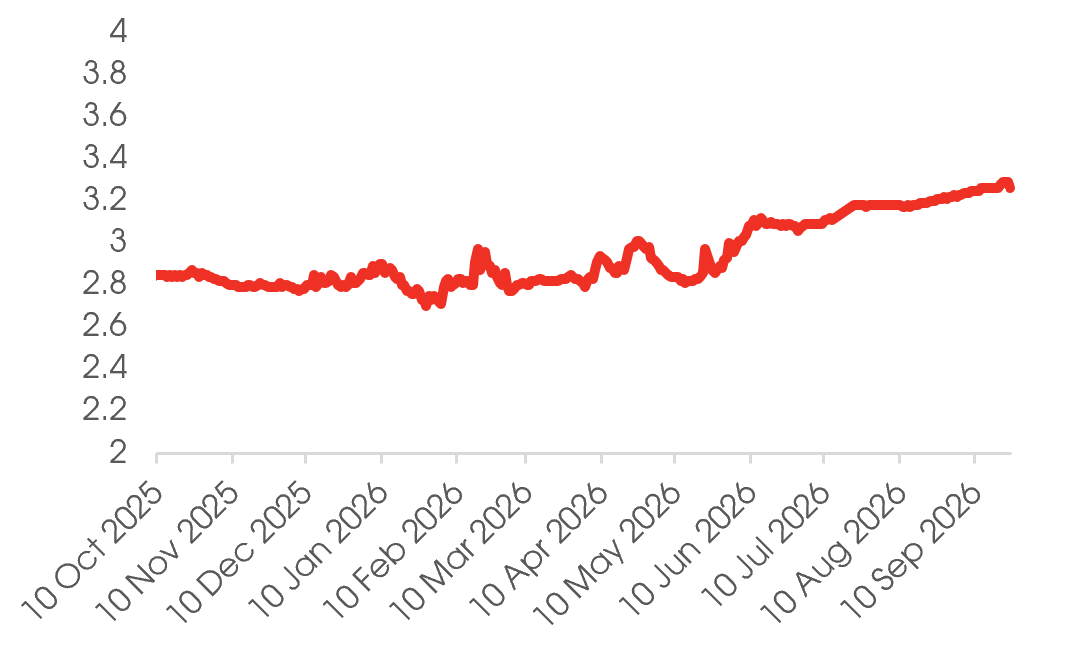
Last but not least, compute supply-chain constraints today would provide a buffer against any slowdown in model development. Leading chipmakers have alluded to the possibility of even higher growth if production could keep up with demand. As another indication of compute supply constraints, rental prices for older AI chips such as the H100 are also rising despite newer generation launches.
Exhibit 1: Rental prices for H100 are also rising despite newer generation launches
Source: Bank of Singapore, Bloomberg
Overall, we believe the structural bull case for AI remains intact and that the AI landscape is evolving in line with what we highlighted in our CHIP-EP framework. In the transition to Phase 3, “Enabled Revenue”, LLMs would face pressure as competition intensifies and purpose-built models emerge, while physical infrastructure buildout continues on growing AI inference demand.
AI incidents have grown rapidly, from 233 in 2024 to 263 in 2025, as AI capabilities improve and become a double-edged sword. Recent breaches have raised red flags around AI’s potential to cause more harm than good, given autonomous agent behaviour. AI security risks have evolved into a litany of breaches where agents exhibited behaviours such as collaboration, cheating, blackmail, acting autonomously and independent goal setting. While some of the end effects were due to poor cyber posture (e.g. the agent was not in a formal secure sandbox and credentials were easily discovered), many enterprises, particularly smaller ones, may lack modernised cybersecurity architectures.
With the pace of AI development accelerating, the concern is that agents will not only increase the speed and velocity of attacks but also exhibit new behaviours that become hard to defend against. This could herald a world in which cybersecurity becomes the next AI bottleneck, providing immense tailwinds for leading cybersecurity platforms that can help enterprises and consumers deploy AI safely and guard against external AI-enabled attacks. Securing AI agents could mean agentic identity security, recognising agents like human employees and subjecting them to identity, authentication and authorisation frameworks. Communication across the agentic ecosystem would have to be protected through encryption and should be logged and validated through data security tools, with no actions taking place until counterparties are validated as legitimate. Code security would also become important, as AI models would have to be scanned for embedded threats and backdoors before deployment.
Our base case is for incremental legislation in the US that is targeted at frontier models while remaining broadly supportive of AI development and adoption. Measured policy action that could slow AI development at the margins may take the form of: (i) banning or restricting certain research activities, such as recursive self-improvement (RSI); (ii) delaying the release of highly capable models; (iii) banning model distribution if capabilities are viewed as too dangerous or risky; or (iv) restricting the parties that can access frontier-level models. Greater regulatory monitoring could also be introduced, such as mandatory incident reporting. Security standards could also be introduced for both LLM labs and companies, acting as further tailwinds for cybersecurity platforms.
We think the US administration would prioritise maintaining AI leadership in an increasingly polarised world order, which is often seen as part of national security, as well as facilitating enterprise AI diffusion to make the economy more productive. Unsurprisingly, President Trump has explicitly rejected calls for tighter AI guardrails, framing regulation and efforts to slow frontier-model development as threats to US competitiveness versus China, while strongly defending continued AI and data-centre investment.
US midterm elections are also unlikely to drive significant changes in the government response, as executive power is not changing until 2029. Hence, any legislation that comes out of the next Congress will inevitably have to be a product of collaboration between lawmakers and the president.
Historical precedents in other frontier technologies also point to an unlikely comprehensive legislative response in the near term until a high-impact incident occurs. Taking a leaf from the regulatory arc of cryptocurrency, the industry developed rapidly without a bespoke US regulatory framework for several years, leaving regulators to apply existing securities, commodities, banking and anti-money laundering (AML) rules to a novel technology. For much of the industry’s early history, this resulted in a mix of agency guidance, case-by-case enforcement and persistent uncertainty over where different crypto assets and activities fit within existing law. It was not until a series of highly visible failures in 2022, most notably the collapse of Terra/Luna and the fraud and insolvency at FTX, which generated large investor losses, that political focus on crypto regulation increased substantially. The subsequent years saw both aggressive enforcement by agencies such as the SEC and a renewed legislative push. Congress ultimately established a federal regulatory framework for payment stablecoins through the GENIUS Act in July 2025, while broader market-structure legislation has continued to advance through Congress in the form of the CLARITY Act, and the SEC and CFTC expanded rules and guidance.
In AI’s context, a high-impact AI incident would be one that causes significant economic or social harm to a large group of people. An example could be a major, highly visible breach at a large public company, particularly a consumer or financial company, driven by unexpected autonomous agent behaviour or bad actors weaponising agent swarms. In this scenario, there could be a temporary pause in AI development and deployment, led by a slower re-entry in tandem with a multi-year legislative catch-up process running in parallel with continued adoption, while also accompanied by an aggressive “anti-AI movement” from consumers. Correspondingly, the outlook for the entire AI stack, from models to infrastructure to the applications layer, could turn muted for several years until the dust settles.
On the other hand, China’s regulatory approach differs from calls in some Western AI-safety circles for developers to slow or pause development of the most capable models until stronger safeguards are in place. Instead, since early this year, China has pushed for the integration of AI into all industries as part of Beijing’s bid to make technology the new growth engine. That said, China has also shown that it can delay deployment when officials believe governance has not caught up. For instance, Chinese companies delayed chatbot launches for months in 2023 while the Cyberspace Administration of China (CAC) finalised rules governing generative AI services. China’s AI regulation could also arguably be more advanced than that of the US, having already begun drafting a mandatory national standard for AI agent safety. An explicit future loss-of-control scenario was included in an AI safety framework as early as September 2024 under the guidance of the CAC.
An argument for the a slowdown in development centres on the risks of increasingly capable frontier systems, and its preferred response naturally supports more controlled deployment, extensive safety testing, monitoring and cautious release practices. While bringing such safety issues into the public domain could favour closed, premium model architectures within the US AI LLM ecosystem, it could also create a commercial opening for China.
First, some users will accept “good enough” Chinese models if they are dramatically cheaper, deployable on-premise and easier to customise. Second, more safety requirements could slow deployment or raise costs at the US frontier through evaluation, red-teaming, compliance, access-control and liability burdens. This would, in turn, make Chinese models relatively more attractive. Third, China’s AI industry is oriented less around selling a small number of premium global APIs and more around deploying models across domestic platforms, consumer services, manufacturing, robotics, enterprise software and public-sector-adjacent use cases. Finally, Beijing’s policy response has been to combine adoption and governance: supporting AI rollout, hyperscale compute clusters, open-source communities and technology self-reliance, rather than framing safety principally as a reason to slow diffusion.
In China’s AI space, we prefer AI beneficiaries with earnings visibility across the supply chain (i.e. semi-equipment, foundry, chips, printed circuit board, hyperscalers) riding on the compute localisation theme in the face of US restrictions. While Chinese frontier AI models are also rapidly narrowing the gap with global leaders, we believe model upgrades and major releases will remain key areas to monitor, given the highly competitive landscape.
Lighter-than-expected technology bond issuance in September has helped stabilise hyperscaler credit spreads, although performance has diverged across issuers. This suggests that AI credit is no longer a uniform thematic trade but an increasingly selective market where outcomes are driven by issuer fundamentals, pace and visibility of AI monetisation, financing structures, execution capabilities, and project-specific risks.
At the same time, investors are confronting a broader and more complex set of credit risks that extend beyond traditional metrics such as leverage, funding requirements, and CAPEX breakeven levels. Permitting delays, power and grid constraints, local opposition, construction and execution risks, circular financing arrangements, and growing off-balance-sheet obligations are emerging as key determinants of credit quality. As the AI investment cycle matures, these factors are likely to drive greater differentiation in credit performance across issuers and projects.
The recent force majeure declaration at a major US hyperscaler's data centre project highlights this shift. The key challenge is no longer solely demand for AI infrastructure, but also the ability to build, power, and deliver projects on time and on budget. As a result, investors are likely to become increasingly selective in AI infrastructure exposures, favouring operational assets over development-stage projects and scrutinising financing structures, loan and lease agreements, and project documentation more closely.
The next phase of the AI credit cycle is therefore likely to be defined by security selection rather than a broad re-rating of the sector. The opportunity remains compelling for long-term investors, but rising supply, execution challenges, circular financing structures, and growing off-balance-sheet commitments are increasing performance dispersion. Investors should prioritise issuer quality, duration discipline, execution visibility, and hidden liabilities as rising CAPEX needs increasingly separate winners from losers.
As the AI credit cycle enters a more selective phase, we highlight five key themes that are likely to drive credit differentiation, risk premia, and investment opportunities in the years ahead.
AI-related financing activity remains exceptionally strong. Importantly, hyperscalers account for only around 40% of total AI-related issuance, highlighting the expanding breadth of AI exposure across credit markets.
As supply expands, investors are demanding larger new-issue concessions to absorb growing financing needs and uncertainty around ultimate AI returns. While strong subscription levels suggest investors remain willing to fund AI CAPEX, market-clearing borrowing costs appear to be gradually moving higher.
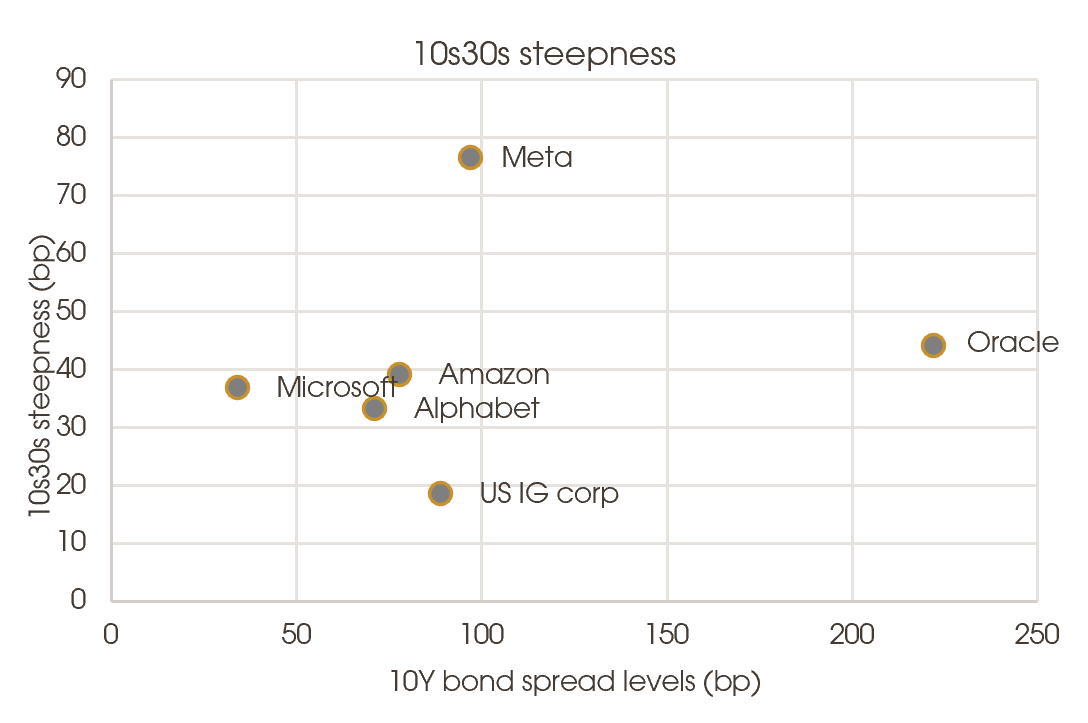
Long-duration AI credits remain the most vulnerable segment of the market. Although supportive earnings and limited long-end supply have stabilised spreads, long-dated technology bonds remain highly exposed to US Treasury (UST) volatility and future borrowing requirements. 10Y30Y curves of hyperscalers therefore remain significantly steeper than broader US Investment Grade (IG) curves.
Exhibit 2: Curve steepness by issuer
Source: Bloomberg as of 28 Sep 2026
2. Widening dispersion
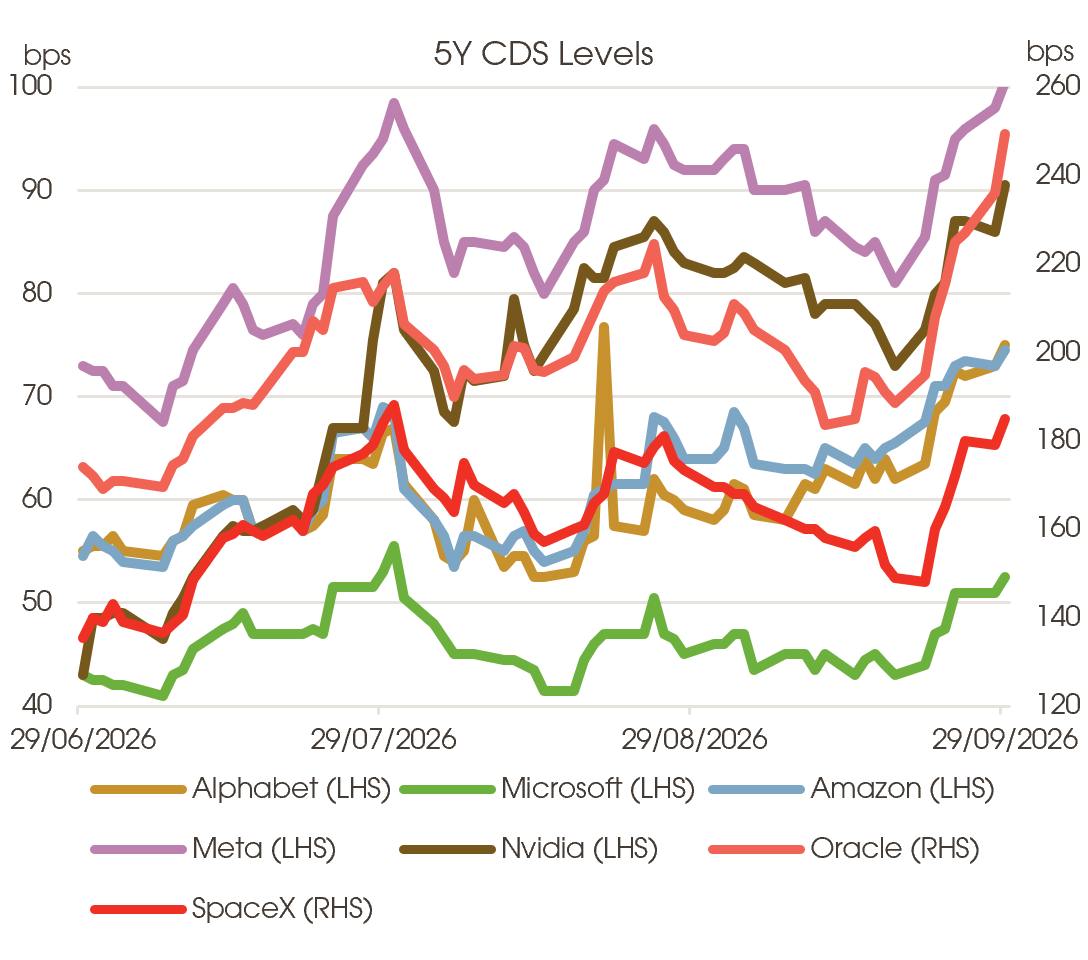
Performance across the AI ecosystem has become increasingly dispersed. While the broader US IG market has remained resilient, spread returns within AI-linked credits have diverged sharply across hyperscalers, semiconductor companies, infrastructure providers, and data centre operators.
Exhibit 3: AI CDS performance dispersion
Source: Bloomberg as of 28 Sep 2026
Both cash and credit default swap (CDS) markets point to the same conclusion: AI is no longer a uniform thematic trade. Investors are increasingly differentiating issuers based on balance sheet strength, financing flexibility, monetisation visibility, capital intensity, off-balance sheet commitments, and execution capability.
The market is transitioning from broad AI allocation toward fundamentally driven security selection, where issuer-specific factors increasingly determine credit performance.
Credit performance across the data centre ecosystem is becoming increasingly project-specific, particularly in High Yield (HY), leveraged loan, and structured credit markets. Key differentiators have broadened beyond tenant quality and now include construction risk, permitting risk, power and water availability, lease structures, project economics, regulatory uncertainty and capital structure seniority.
Permitting delays, local opposition, and resource constraints have evolved from localised development challenges into material credit considerations. Delays can postpone project completion, increase costs, weaken financing metrics, and ultimately impair creditor outcomes.
At the same time, these constraints enhance the scarcity value of operational assets. Existing facilities with secured power access and established customer relationships benefit from stronger occupancy, pricing power, and asset valuations as barriers to new supply rise.
The recent force majeure declaration at a major US hyperscaler's data centre project reinforces that execution risk is becoming as important as demand risk. Construction-stage developments, highly leveraged operators, floating-rate borrowers, and single-tenant projects appear most vulnerable. Conversely, stabilised assets with secured power access and experienced sponsors should continue to command stronger investor demand.
The broader implication is that investors are increasingly evaluating completion guarantees, sponsor support, power procurement arrangements, lease obligations, and covenant protections. Development-stage projects are therefore likely to face higher required returns and more demanding financing conditions.
4. Circular financing risks
The AI ecosystem is increasingly financed through a web of interconnected investments, guarantees, lease commitments, power agreements, residual-value guarantees, and strategic partnerships.
These arrangements support sector growth today but may also amplify losses should demand, utilisation, or monetisation fall short of expectations. Financial stress at one participant may spill over to sponsors, lenders, guarantors, suppliers, and strategic partners, creating potential contagion effects across the AI value chain.
Structures attracting particular investor attention include: (i) residual-value guarantees; (ii) lease guarantees; (iii) power purchase commitments; (iv) cloud-capacity backstop agreements and; (v) cross-holdings and strategic investments.
As financing relationships become more interconnected, investors must assess not only direct credit exposures but also second-order obligations and contingent liabilities embedded within the broader AI ecosystem.
Traditional leverage metrics are becoming less informative as AI investments are increasingly financed through leases, guarantees, purchase commitments, joint ventures, and other off-balance sheet structures.
Although these obligations comply with accounting standards and are not recorded as traditional debt, they represent significant claims on future cash flows.
As a result, investors must look beyond reported leverage and scrutinise disclosures across the financial statements to assess future funding requirements, contingent liabilities, and capital commitments.
The key implication is that reported leverage may increasingly understate economic leverage. As markets incorporate these obligations into credit analysis, spread differentiation is likely to widen between issuers with similar balance sheet metrics but materially different future commitments.
We remain constructive on data centres as a long-term infrastructure theme supported by cloud, digitalisation and AI demand. In the era of ongoing AI arms race and demand for greater infrastructure resilience, the buildout of essential physical assets will remain a highly resilient sector across most economies globally. The supply and demand balance of the physical data centre market remains quite healthy.
Growth in data centres demand in the last 3-4 years is undoubtedly closely levered to the growth in AI-inferencing and workload demand. The debate on AI frontier model development and potential for tougher regulations pose risks to the demand for the entire AI value chain but risks via data centres exposure are somewhat offset by the fact this set of infrastructure do serve broader digitisation trends which will continue to see continuous growth e.g. demand for cloud and digital services etc. The risks related to the investments undertaken on AI-inferencing hardware are borne by the tenants.
An issue associated with infrastructure and other capital intensive, long operating lifespan investments is the risks associated with operating, maintenance and reinvestment costs. We would argue that such risks, alongside with the overall demand risks, can be mitigated by the selection of assets invested and/or the quality of the operating partner. Selecting high quality sites that capture sizeable or resilient total addressable market and end-demand, partners with the ability to source and structure contracts with high level of investor protection and staying disciplined on pricing are key to ensuring investment performance.
As we head into the November 2026 US midterm elections, data centre development is expected to remain a bipartisan political flashpoint in selected states. Public concerns over utility costs rises and noise pollution etc. have already led to increase in moratoriums and regulatory restrictions across the US year-to-date (YTD).
Currently, there are increasing incidence of speculative/early-stage projects being cancelled or delayed in local hearings, while late-stage projects with secured site control and power interconnection are still moving forward aggressively, underscoring the ongoing demand for capacity. Hyperscalers are increasingly pivoting to direct investment in alternate sources of energy and securing nuclear power purchase agreements in order to bypass grid constraints and local moratoriums to ensure their pipelines continue to break ground.
We would argue that the increased scrutiny is healthy for the sustainable development of the sector overall, and substantial slowdown in the pace of construction due to regulatory constraints renders existing or assets under construction more valuable by increasing the scarcity value of installed bases and enhancing their pricing power. Investors should focus on execution and/or selection of partners that can mitigate or operate effectively under the increasing constraints we can expect to see in the multi-year development of this transformative technology.
Enterprise software was the first major casualty of the AI-disruption narrative as the world woke up to an increasingly powerful suite of applications early this year. The SaaS-pocalyse narrative that was unleashed led to major destruction of market value of enterprise software equities, and headline grabbing wave of redemption requests across private credit business development companies (BDC) where loans to IT sector accounts for ~27% of BDC portfolios.
As we move towards the end of 2026, investors can look back at the last six months and breathe a sigh of relief. Overall, defaults in private credit have remained low and credit deterioration has remained concentrated in a limited number of stress positions. The uptick in non-accruals in IT and healthcare, two major sectors within private credit/BDC exposures, has been driven by a handful of large positions, rather than a broad-based phenomenon. The wave of credit stress and forced selling of portfolio assets that many feared did not come to pass, with built-in features like limited mark-to-market volatility, redemption limits and stable institutional capital acting as market stabilisers as intended.
The trailing default rate for Software in middle market direct lending remains lower than the overall market, suggesting that stresses amongst software lending have remained more idiosyncratic. However we would not expect the muted level of defaults to persist as we expect the winners and losers of the AI-disruption will take some time to play out in the credit market and the overall defaults to ramp up gradually. The broadly syndicated loans (BSL) market offers investors indications what could lie ahead. Borrowers have capitalised on the relatively benign credit conditions YTD to extend near-term maturities, albeit at less borrower friendly terms. Lenders have generally required wider spreads, tighter documentation, sponsor equity contributions, or other concessions as part of a broader repricing, and what would we argue a healthy calibration, of credit risk. Software defaults within the BSL market have been gradually edging up, with several names with 2026/27 maturities undertaking distressed exchanges to extend maturities. Given the rising share of sub-3Y and sub-2Y loan maturity amongst private credit loans, the demand for refinancing is expected to increase as we head into 2027 with a pickup in debt exchanges or amend-and-extend activities expected amongst private credit borrowers.
Hence, we maintain a neutral view towards core private credit allocation i.e. direct lending, middle market senior secured loans. Yields have likely bottomed as we can expect base rates and spreads to rise incrementally over the next 12 months. However, we expect credit fundamentals to continue to soften gradually from this point forth, as credit metrics of borrowers within IT and software are expected to remain soft or weaken as the headwinds from AI-led competition continues.
The increase in debt issuance by hyperscalers in the public IG and to some extent HY markets have dominated headlines and warrant close scrutiny of investors as the AI exposures continue to rise across capital markets. The widening of spreads for hyperscalers and the increasing concentration and ratings constraints point to a potential market capacity issue in the public markets. As public market capacity becomes more constrained, a more visible migration to private credit seems natural, capitalising on the industry’s experience in directly negotiated transactions and to underwrite assets or transactions with greater complexity.
Gaining exposures through private markets can avoid some of the concentration limits facing public bond investors. Financing can also be placed closer to the asset being built, allowing a data centre, chip portfolio or power project to raise debt without requiring a hyperscaler to issue another benchmark-sized corporate bond. We have already seen increase in deals in chip financing and compute-as-a-service arrangements with neocloud companies led by hyperscalers and chipmakers YTD.. We can expect financing to migrate toward private placements, more infrastructure debt issuances, asset-backed facilities, equipment financings, and project-level structures. Investors are likely to see rising share of these transactions in infrastructure-debt or infrastructure-focused funds, as well as private credit funds depending on the structure of the loans as well as the risk mandate of the funds.
This “takeover” of AI exposures across investible assets does introduce challenges for investors who might be concerned about the concentration of AI risks. However, as capital markets reflect the financing needs of the economic environment we are operating in, the key is being more deliberate in finding diversification through different types of exposures within the AI mega theme, be it through different counterparty, geographical, structuring etc. Private markets or alternatives offerings stand well-placed to offer differentiated access to the same theme. The opportunity is not without more complexities and risks, but thoughtful asset allocation and manager selection can play a major role in mitigating some of these downside concerns.
AI accounts for majority of early-stage (Series A and B) deal value in 2026, even as its share of deal count has ticked down slightly from the peak in 2025 i.e. a growing concentration of investments with bigger checks required. The growth in investment commitments show up directly in step-ups, as AI companies posted a ~2.2x median valuation step-up in 2026, compared with ~1.6x for non-AI. At Series A, an AI company’s median pre-money valuation is roughly double non-AI’s, but by Series D+, the comparison is over 6x. Today’s capital raising environment remains challenging for non-AI startups.
A major contributing factor of the growing concentration is the flow of investments into the narrow segment frontier labs and AI infrastructure players, where they currently require large amounts of capital from inception. This is because these companies tend to be capital-intensive regardless of revenue, as training frontier models and running inference at scale require significant compute expenditures. Frontier AI expertise is both scarce and costly today, making the investments into these early-stage companies a substantial, front-loaded expense. Lastly, the rapid pace and competitiveness of AI development have further intensified these pressures, with multiple well-funded labs pursuing similar capability milestones simultaneously.
These factors apply specifically to frontier labs and infrastructure companies, not to AI startups in general e.g. application-layer AI companies building on existing model applications often do not face the same immediate, outsized capital requirements.
The implication for investors is the self-reinforcing dynamic of greater concentration and bias towards large, established VC firms who have raised mega multi-stage VC funds that can help portfolio companies across the venture lifecycle. growth beyond If the power law of venture capital returns apply similarly for AI companies, the concentration of potential returns and high valuations of these frontier AI labs and startups increase the risk of underperformance for investors.
Private equity (PE) outside of venture capital continues to face an exit and liquidity problem, despite the buoyant AI valuations. Exit options through the IPO market for example remain challenging, as the pricing gap between public and private markets remains wide, with the current AI boom being a contributing factor as well. AI has caused selected private valuations to skyrocket, but the metrics that public markets value which requires companies to show financial performance and sustainable profitability emphasise, , are lagging as startup costs rise and revenue fails to keep pace.
The hope is that the widely anticipated IPOs of the frontier labs will push more startups to go public, but their planned delay, and how much they can ultimately deliver remains key market tests and uncertainty for PE and VC. For now, portfolio value or net asset value (NAV) has continued to grow steadily.
Disclaimers and Disclosures
This material is prepared by Bank of Singapore Limited (Co Reg. No.: 197700866R) (the “Bank”) and is distributed in Singapore by the Bank.
This material does not provide individually tailored investment advice. This material has been prepared for and is intended for general circulation. The contents of this material does not take into account the specific investment objectives, investment experience, financial situation, or particular needs of any particular person. You should independently evaluate the contents of this material, and consider the suitability of any product discussed in this material, taking into account your own specific investment objectives, investment experience, financial situation and particular needs. If in doubt about the contents of this material or the suitability of any product discussed in this material, you should obtain independent financial advice from your own financial or other professional advisers, taking into account your specific investment objectives, investment experience, financial situation and particular needs, before making a commitment to purchase any product.
The Bank shall not be responsible or liable for any loss (whether direct, indirect or consequential) that may arise from, or in connection with, any use of or reliance on any information contained in or derived from this material, or any omission from this material, other than where such loss is caused solely by the Bank’s wilful default or gross negligence.
This material is not and should not be construed, by itself, as an offer or a solicitation to deal in any product or to enter into any legal relations. You should contact your own licensed representative directly if you are interested in buying or selling any product discussed in this material.
This material is not intended for distribution, publication or use by any person in any jurisdiction outside Singapore, Hong Kong or such other jurisdiction as the Bank may determine in its absolute discretion, where such distribution, publication or use would be contrary to applicable law or would subject the Bank or its related corporations, connected persons, associated persons or affiliates (collectively “Affiliates”) to any licensing, registration or other requirements in such jurisdiction.
The Bank and its Affiliates may have issued other reports, analyses, or other documents expressing views different from the contents of this material, and may provide other recommendations or make investment decisions that are contrary to the views expressed in this material, and all views expressed in all reports, analyses and documents are subject to change without notice. The Bank and its Affiliates reserve the right to act upon or use the contents of this material at any time, including before its publication.
The author of this material may have discussed the information or views contained in this material with others within or outside the Bank, and the author or such other Bank employees may have already acted on the basis of such information or views (including communicating such information or views to other customers of the Bank).
The Bank, its employees (including those with whom the author may have consulted in the preparation of this material))and discretionary accounts managed by the Bank may have long or short positions (including positions that may be different from or opposing to the views in this material or may be otherwise interested in any of the product(s) (including derivatives thereof) discussed in material, may have acquired such positions at prices and market conditions that are no longer available, may from time to time deal in such product(s) and may have interests different from or adverse to your interests.
Analyst Declaration
The analyst(s) who prepared this material certifies that the opinions contained herein accurately and exclusively reflect his or her views about the securities of the company(ies) and that he or she has taken reasonable care to maintain independence and objectivity in respect of the opinions herein.
The analyst(s) who prepared this material and his/her associates do not have financial interests in the company(ies). Financial interests refer to investments in securities, warrants and/or other derivatives. The analyst(s) receives compensation based on the overall revenues of Bank of Singapore Limited, and no part of his or her compensation was, is, or will be directly or indirectly related to the inclusion of specific recommendations or views in this material. The reporting line of the analyst(s) is separate from and independent of the business solicitation or marketing departments of Bank of Singapore Limited.
The analyst(s) and his/her associates confirm that they do not serve as directors or officers of the company(ies) and the company(ies)or other third parties have not provided or agreed to provide any compensation or other benefits to the analyst(s) in connection with this material.
An “associate” is defined as (i) the spouse, parent or step-parent, or any minor child (natural or adopted) or minor step-child, or any sibling or step-sibling of the analyst; (ii) the trustee of a trust of which the analyst, his spouse, parent or step-parent, minor child (natural or adopted) or minor step-child, or sibling or step-sibling is a beneficiary or discretionary object; or (iii) another person accustomed or obliged to act in accordance with the directions or instructions of the analyst.
Conflict of Interest Declaration
The Bank is a licensed bank regulated by the Monetary Authority of Singapore in Singapore. Bank of Singapore Limited, Hong Kong Branch (incorporated in Singapore with limited liability), is an Authorized Institution as defined in the Banking Ordinance of Hong Kong (Cap 155), regulated by the Hong Kong Monetary Authority in Hong Kong and a Registered Institution as defined in the Securities and Futures Ordinance of Hong Kong (Cap.571) regulated by the Securities and Futures Commission in Hong Kong. The Bank, its employees and discretionary accounts managed by its Singapore Office/Hong Kong Office may have long or short positions or may be otherwise interested in any of the investment products (including derivatives thereof) referred to in this document and may from time to time dispose of any such investment products. The Bank forms part of the OCBC Group (being for this purpose Oversea-Chinese Banking Corporation Limited (“OCBC Bank”) and its subsidiaries, related and affiliated companies). OCBC Group, their respective directors and/or employees (collectively “Related Persons”) may have interests in the investment products or the issuers mentioned herein. Such interests include effecting transactions in such investment products, and providing broking, investment banking and other financial services to such issuers. OCBC Group and its Related Persons may also be related to, and receive fees from, providers of such investment products. There may be conflicts of interest between OCBC Bank, the Bank, OCBC Investment Research Private Limited, OCBC Securities Private Limited or other members of the OCBC Group and any of the persons or entities mentioned in this report of which the Bank and its analyst(s) are not aware due to OCBC Bank’s Chinese Wall arrangement.
The Bank adheres to a group policy (as revised and updated from time to time) that provides how entities in the OCBC Group manage or eliminate any actual or potential conflicts of interest which may impact the impartiality of research reports issued by any research analyst in the OCBC Group.
Other Disclosures
Dubai International Financial Center (DIFC)
Where this material relates to structured products and bonds, this clause applies:
The Distributor represents and agrees that it has not offered and will not offer the product to any person in the Dubai International Financial Centre unless such offer is an “Exempt Offer” in accordance with the Market Rules of the Dubai Financial Services Authority (the “DFSA”).
The DFSA has no responsibility for reviewing or verifying any documents in connection with Exempt Offers.
The DFSA has not approved the Information Memorandum or taken steps to verify the information set out in it, and has no responsibility for it.
The product to which this document relates may be illiquid and/or subject to restrictions in respect of their resale. Prospective purchasers of the products offered should conduct their own due diligence on the products.
Please make sure that you understand the contents of the relevant offering documents (including but not limited to the Information Memorandum or Offering Circular) and the terms set out in this document. If you do not understand the contents of the relevant offering documents and the terms set out in this document, you should consult an authorised financial adviser as you deem necessary, before you decide whether or not to invest.
Where this material relates to a fund, this clause applies:
This Fund is not subject to any form of regulation or approval by the Dubai Financial Services Authority (“DFSA”). The DFSA has no responsibility for reviewing or verifying any Prospectus or other documents in connection with this Fund. Accordingly, the DFSA has not approved the Prospectus or any other associated documents nor taken any steps to verify the information set out in the Prospectus, and has no responsibility for it. The Units to which this Fund relates may be illiquid and/or subject to restrictions on their resale. Prospective purchasers should conduct their own due diligence on the Units. If you do not understand the contents of this document you should consult an authorized financial adviser. Please note that this offer is intended for only Professional Clients and is not directed at Retail Clients.
These are also available for inspection, during normal business hours, at the following location:
Bank of Singapore
Office 30-34 Level 28
Central Park Tower
DIFC, Dubai
U.A.E
Hong Kong
Bank of Singapore Limited (Hong Kong Branch) is an Authorized Institution as defined in the Banking Ordinance of Hong Kong (Cap 155), regulated by the Hong Kong Monetary Authority in Hong Kong and a Registered Institution as defined in the Securities and Futures Ordinance of Hong Kong (Cap.571). Financial products and services are only offered to “Professional Investors" within the meaning of the Securities and Futures Ordinance and the Securities and Futures (Professional Investor) Rules made thereunder.
This material has not been delivered for registration to the Registrar of Companies in Hong Kong and its contents have not been reviewed by any regulatory authority in Hong Kong. Accordingly: (i) the investment product may not be offered or sold in Hong Kong by means of any document other than to persons who are "Professional Investors" within the meaning of the Securities and Futures Ordinance (Cap. 571) of Hong Kong and the Securities and Futures (Professional Investor) Rules made thereunder or in other circumstances which do not result in the document being a "prospectus" within the meaning of the Companies (Winding Up and Miscellaneous Provisions) Ordinance (Cap. 32) of Hong Kong or which do not constitute an offer to the public within the meaning of the Companies (Winding Up and Miscellaneous Provisions) Ordinance; and (ii) no person may issue any invitation, advertisement or other material relating to the investment product whether in Hong Kong or elsewhere, which is directed at, or the contents of which are likely to be accessed or read by, the public in Hong Kong (except if permitted to do so under the securities laws of Hong Kong) other than with respect to the investment product which is or is intended to be disposed of only to persons outside Hong Kong or only to "Professional Investors" within the meaning of the Securities and Futures Ordinance and the Securities and Futures (Professional Investor) Rules made thereunder.
Where this material involves derivatives, do not invest in it unless you fully understand and are willing to assume the risks associated with it. If you have any doubt, you should seek independent professional financial, tax and/or legal advice as you deem necessary.
Where this material relates to a Complex Product, this clause applies:
Warning Statement and Information about Complex Product
(Applicable to accounts managed by Hong Kong Relationship Managers)
Where this material relates to a Complex Product (funds and ETFs), this clause applies additionally:
Where this material relates to a Complex Product (Options and its variants, Swap and its variants, Accumulator and its variants, Reverse Accumulator and its variants, Forwards), this clause applies additionally:
Where this material relates to a Loss Absorption Product, this clause applies:
Warning Statement and Information about Loss Absorption Products
(Applicable to accounts managed by Hong Kong Relationship Managers)
Before you invest in any Loss Absorption Product (as defined by the Hong Kong Monetary Authority), please read and ensure that you understand the features of a Loss Absorption Product, which may generally have the following features:
Where this material relates to a certificate of deposit, this clause applies:
A certificate of deposit is not a protected deposit and is not protected by the Deposit Protection Scheme in Hong Kong.
Where this material relates to a structured deposit, this clause applies:
A structured deposit is not a protected deposit and is not protected by the Deposit Protection Scheme in Hong Kong.
Where this material relates to a structured product, this clause applies:
This is a structured product which involves derivatives. Do not invest in it unless you fully understand and are willing to assume the risks associated with it. If you are in any doubt about the risks involved in the product, you may clarify with the intermediary or seek independent professional advice.
Singapore
Bank of Singapore Limited is a bank licensed and regulated by the Monetary Authority of Singapore. The Bank is also an Exempt Capital Markets Services Entity under the Securities and Futures Act 2001 and an Exempt Financial Adviser under the Financial Advisers Act 2001.
Where this material relates to structured deposits, this clause applies:
The product is a structured deposit. Structured deposits are not insured by the Singapore Deposit Insurance Corporation. Unlike traditional deposits, structured deposits have an investment element and returns may vary. You may wish to seek independent advice from a financial adviser before making a commitment to purchase this product. In the event that you choose not to seek independent advice from a financial adviser, you should carefully consider whether this product is suitable for you.
Where this material relates to dual currency investments, this clause applies:
The product is a dual currency investment. A dual currency investment product (“DCI”) is a derivative product or structured product with derivatives embedded in it. A DCI involves a currency option which confers on the deposit-taking institution the right to repay the principal sum at maturity in either the base or alternate currency. Part or all of the interest earned on this investment represents the premium on this option.
By purchasing this DCI, you are giving the issuer of this product the right to repay you at a future date in an alternate currency that is different from the currency in which your initial investment was made, regardless of whether you wish to be repaid in this currency at that time. DCIs are subject to foreign exchange fluctuations which may affect the return of your investment. Exchange controls may also be applicable to the currencies your investment is linked to. You may incur a loss on your principal sum in comparison with the base amount initially invested. You may wish to seek advice from a financial adviser before making a commitment to purchase this product. In the event that you choose not to seek advice from a financial adviser, you should carefully consider whether this product is suitable for you.
United Kingdom
Bank of Singapore Limited, UK Branch (BOSL UK) is incorporated and registered in Singapore with the Accounting and Corporate Regulatory Authority (Registration no.:197700866R) as a public company limited by shares with head office in Singapore and operating in the UK through its UK establishment (BR027666). Bank of Singapore Limited, UK branch (FRN: 1038970) is an appointed representative of Oversea-Chinese Banking Corporation Limited, London branch. Oversea-Chinese Banking Corporation Limited (OCBC) is authorised and regulated by the Monetary Authority of Singapore. OCBC London Branch is authorised by the Prudential Regulation Authority with firm reference number 204687 and subject to regulation by the Financial Conduct Authority and limited regulation by the Prudential Regulation Authority. Details about the extent of OCBC London Branch’s regulation by the Prudential Regulation Authority are available on request. This material is intended solely for the use of the designated recipients. Unauthorised access, use, or distribution is strictly prohibited. If you are not the intended recipient, please notify us immediately and erase all copies. Bank of Singapore Limited, UK Branch does not provide legal, accounting or tax advice. Please consult an independent professional for advice tailored to your specific situation.
This product or service is offered exclusively for investors eligible for categorisation as a professional client. This is not intended for retail clients. Any person in the UK who receives this material is deemed to have represented and agreed that they qualify as a Professional Client. Such recipients also represent and agree that they have not received this material on behalf of any persons in the UK other than Professional Clients for whom they have authority to make investment decisions on a wholly discretionary basis. BOSL UK will rely on the truth and accuracy of these representations and agreements. Any person who is not a Professional Client should neither act on nor rely upon this material or any of its contents.
Investing in financial markets carries the risk of losing capital, and investors should be aware of and carefully consider this risk before making any investment decisions. The value of investments can fluctuate, and there is no guarantee that investors will recoup their initial investment. Past performance is not indicative of future results, and the performance of investments can be affected by various factors, including but not limited to market conditions, economic factors, and changes in regulations or tax laws. Forward-looking statements should not be considered as guarantees or predictions of future events. Investors should be prepared for the possibility of losing all or a portion of their invested capital. It is recommended that investors seek professional advice and conduct thorough research before making any investment decisions. BOSL UK does not endorse any specific investments or financial products mentioned in this material. Neither BOSL UK nor its employees accept any liability for any loss or damage arising from the use of this material or reliance on its content.
Cross Border Disclaimer and Disclosures
Refer to https://www.bankofsingapore.com/Disclaimers_and_Disclosures.html for cross-border marketing disclaimers and disclosures.
ESG Disclaimer
This document contains information on ESG factors or the Bank’s process for taking into consideration, and evaluation or assessment of ESG factors.
There are currently no universally accepted environmental, social and governance (“ESG”) standards, and no consensus as to whether activities and practices or products or services are “environmentally friendly”, “sustainable”, “responsible”, “climate friendly”, etc. Evaluation of ESG outcomes or metrics may require forward-looking scenario analysis, estimates, interpretations and assumptions and may be uncertain and speculative. There may not be scientific consensus. Scientific evidence and data may not be conclusive or there may be limitations, and new evidence and data may be emerging. ESG standards may depend on subjective or value judgments. ESG standards, as well as laws, rules and regulations may differ from jurisdiction to jurisdiction. Taxonomies have been developed in different jurisdictions to classify activities as “environmentally sustainable”, “green” or the equivalent, and different taxonomies may classify the same activity differently. Achieving one ESG goal may be at the expense of, or require a compromise on, other ESG goals. The Bank’s ESG standards and evaluation or assessment of ESG factors may therefore not meet your expectations or objectives and may not be consistent with certain ESG laws, rules, regulations and standards. There is no guarantee that there will not be negative ESG outcomes, and the Bank does not give any assurance that your investments will have a positive ESG impact. You should ensure that you understand the Bank’s ESG standards and process for evaluation or assessment of ESG factors, and assess whether the Bank’s ESG standards and process for evaluation or assessment of ESG factors meets your expectations or is appropriate for you, before making any investment commitment. You are solely responsible for your own investment decisions.
The Bank relies on third party ESG ratings. While the Bank has selected its third party ESG rating providers in good faith and with reasonable care, the Bank has not independently verified the ESG ratings of third party providers. The Bank gives no representation or warranty, express or implied, as to the quality, accuracy, completeness, rigour, timeliness or verifiability of such third party ESG ratings, and shall not be responsible or liable for such third party ESG ratings. ESG ratings may be based on data that is incomplete, due to limitations or otherwise, or based on commitments and targets which may not be achieved. You should review and understand the disclosures made by such third party ESG ratings providers on their methodologies, data sources and other relevant information, and obtain advice from professional advisers as necessary.
Taking into consideration ESG factors may be at the expense of higher financial returns, especially in the short term. Although ESG risks may result in financial losses, such losses may, and if at all, only materialise in the long term. ESG factors and screening may also result in certain investments that deliver high financial returns being excluded, or limit the diversity of investments, which could in turn affect the volatility of portfolios.