





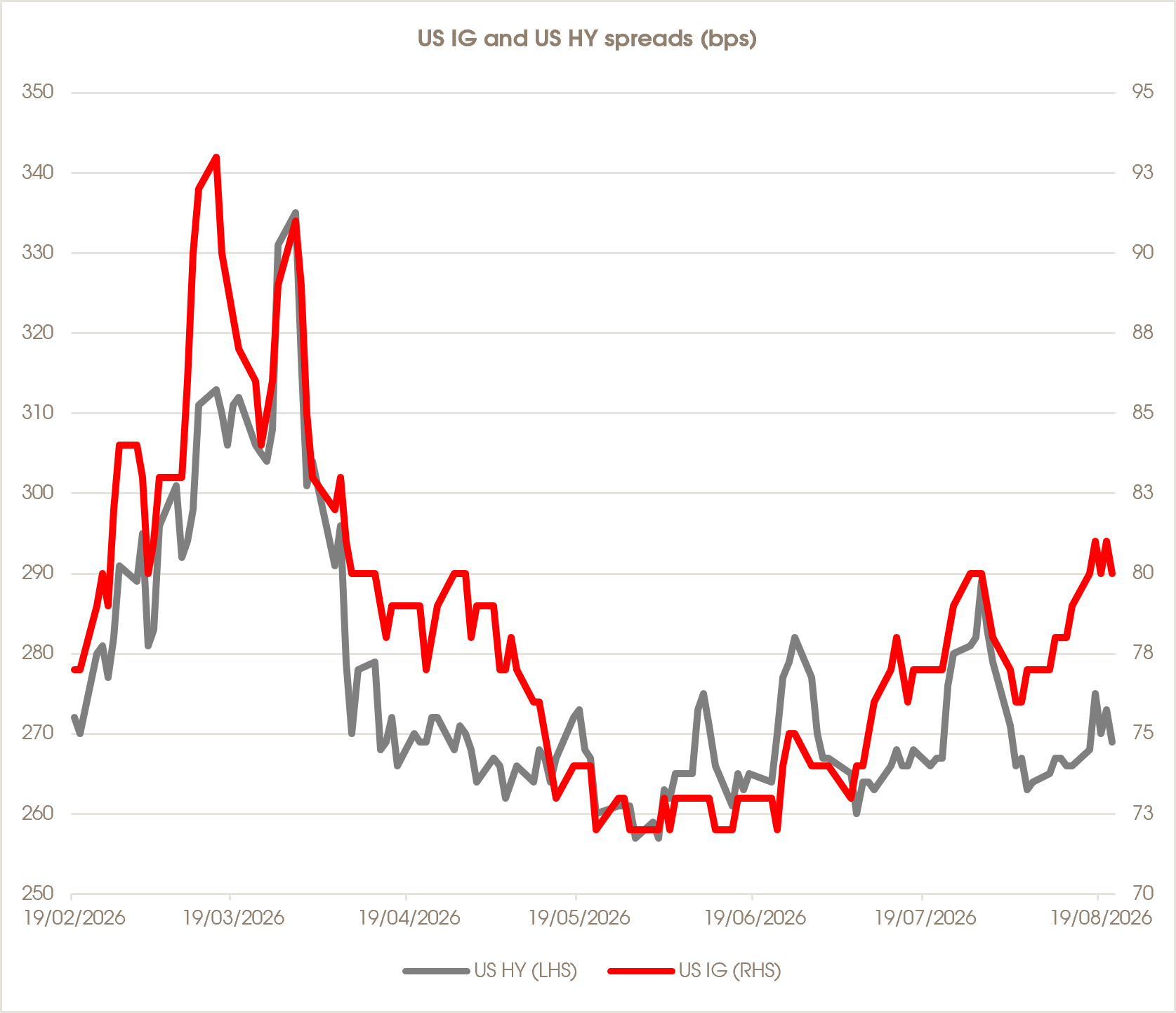
Recent US Treasury buyback activity has contributed to heightened volatility in long-end interest rates, although credit spreads have remained notably resilient.
Exhibit 1: Credit spreads resilient
Source: Bloomberg as of 21 Aug 2026
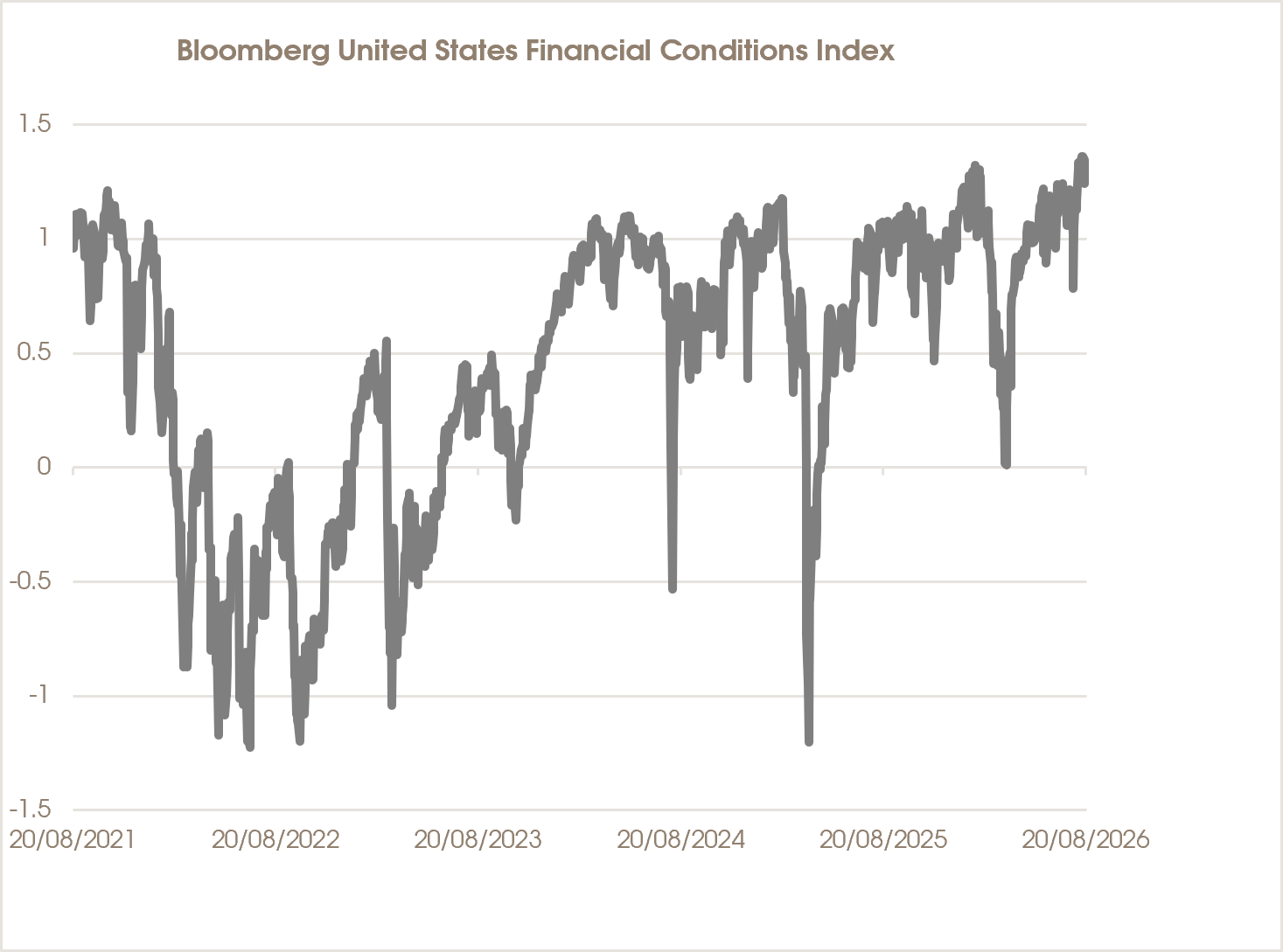
While a further rise in long-end yields could eventually pressure credit valuations by tightening financial conditions, that risk has yet to materialise meaningfully. US financial conditions remain broadly accommodative, as reflected by the Bloomberg US Financial Conditions Index, which continues to indicate a relatively loose backdrop for risk assets.
Exhibit 2: US Financial Conditions Index
Source: Bloomberg as of 21 Aug 2026
Although investors continue to grapple with macroeconomic uncertainty and questions surrounding the sustainability of the AI-led investment cycle, corporate fundamentals remain largely stable across most sectors in US IG.
As a result, IG credit spreads should remain largely rangebound in the near term, unless the market experiences another significant bout of rate volatility or a further sharp rise in global long-end bond yields.
The immediate focus for credit markets centers on two key events in the coming weeks: the Jackson Hole symposium and the seasonal post-Labour Day surge in corporate bond issuance.
Consequently, while absolute yields remain attractive and corporate fundamentals continue to provide support, we believe spreads could remain under modest pressure, given current tight levels and near-term event risks.
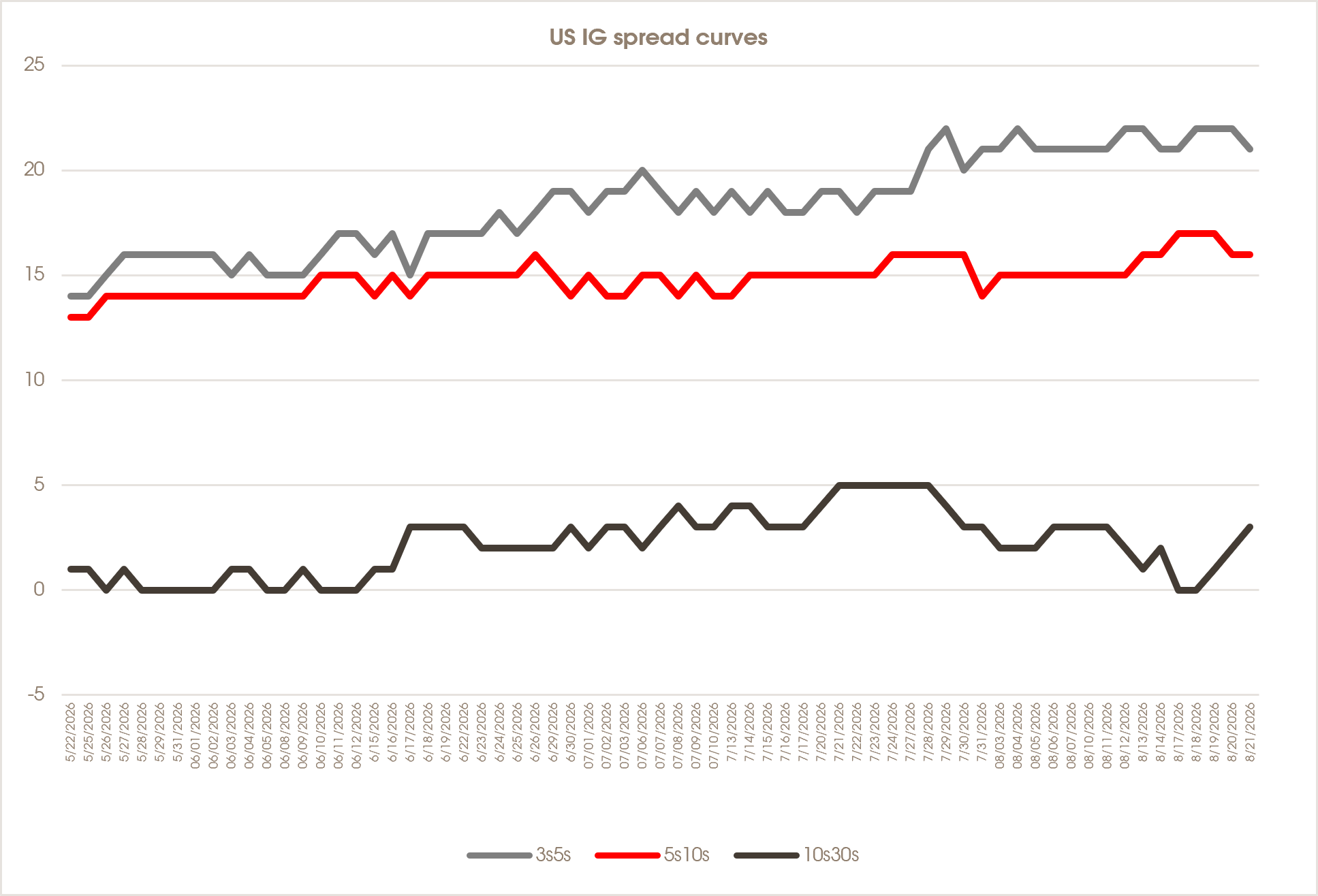
Within the credit market, spread curves have displayed divergent behaviour across maturities. The long-end of the curve generally stayed range bound and is around mid-point (55%) of its three-month range. In contrast, the short and belly of the curves have steepened, with the 3s5s curve and 5s10s curve reaching 74% and 82% of its three-month range respectively. Consequently, this has improved relative value in the short and belly of the curve, while the long-end of the curve could be vulnerable if rates volatility increases further.
Exhibit 3: US IG spread curves
Source: Bloomberg as of 21 Aug 2026
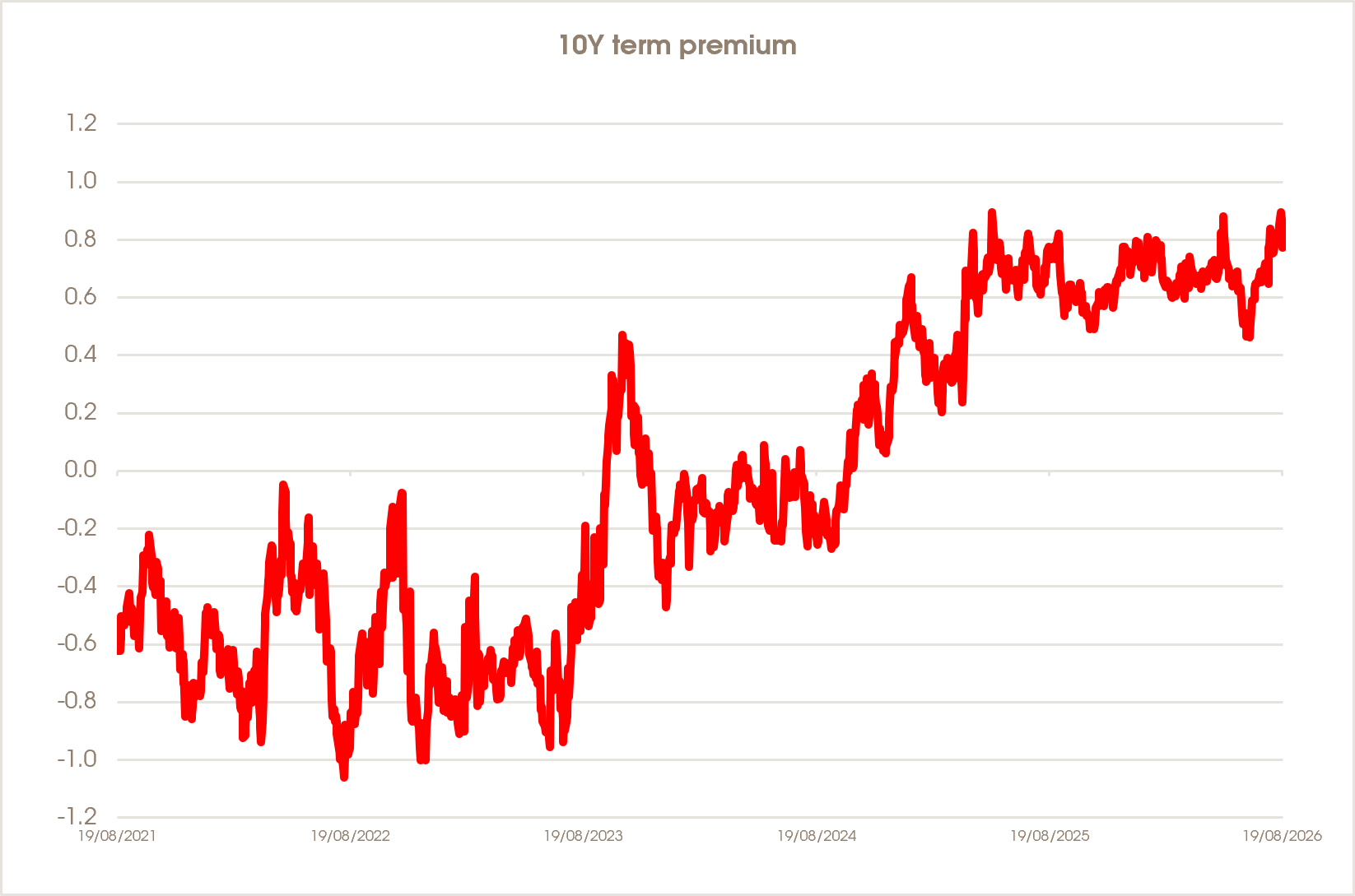
The broader rates backdrop has also undergone a notable shift. As of 24 August 2026, the UST 2s30s curve has steepened by approximately 33bps since reaching its one-year low in June as 30Y yields climbed to 5.25%, their highest level since mid-2007, reflecting a wider global bear-steepening trend.
Importantly, the rise in nominal UST yields has been driven primarily by higher real yields rather than inflation expectations. While inflation expectations remain relatively subdued on a year-to-date (YTD) basis, they have gradually edged higher over the last two months.
|
UST |
Current |
YTD chng (bps) |
||||
|
Nominal yield |
Real |
Breakeven yield |
Nominal yield |
Real |
Breakeven |
|
|
2Y |
4.24 |
1.90 |
2.33 |
76 |
72 |
4 |
|
5Y |
4.42 |
2.09 |
2.34 |
70 |
63 |
7 |
|
10Y |
4.73 |
2.40 |
2.33 |
57 |
48 |
9 |
|
30Y |
5.27 |
3.02 |
2.25 |
43 |
40 |
3 |
Source: Federal Reserve Bank of New York, Bloomberg as of 21 Aug 2026
Market pricing for the front end of the yield curve has undergone several notable shifts this year. Investors began the year anticipating policy easing by the Fed, then reassessed the outlook and priced in one to two rate hikes by mid-2026. More recently, softer labour market indicators and contained inflation data have led to a partial reversal of those expectations. Based on futures pricing as of 21 August 2026, markets now anticipate roughly one rate hike by the end of 2026.
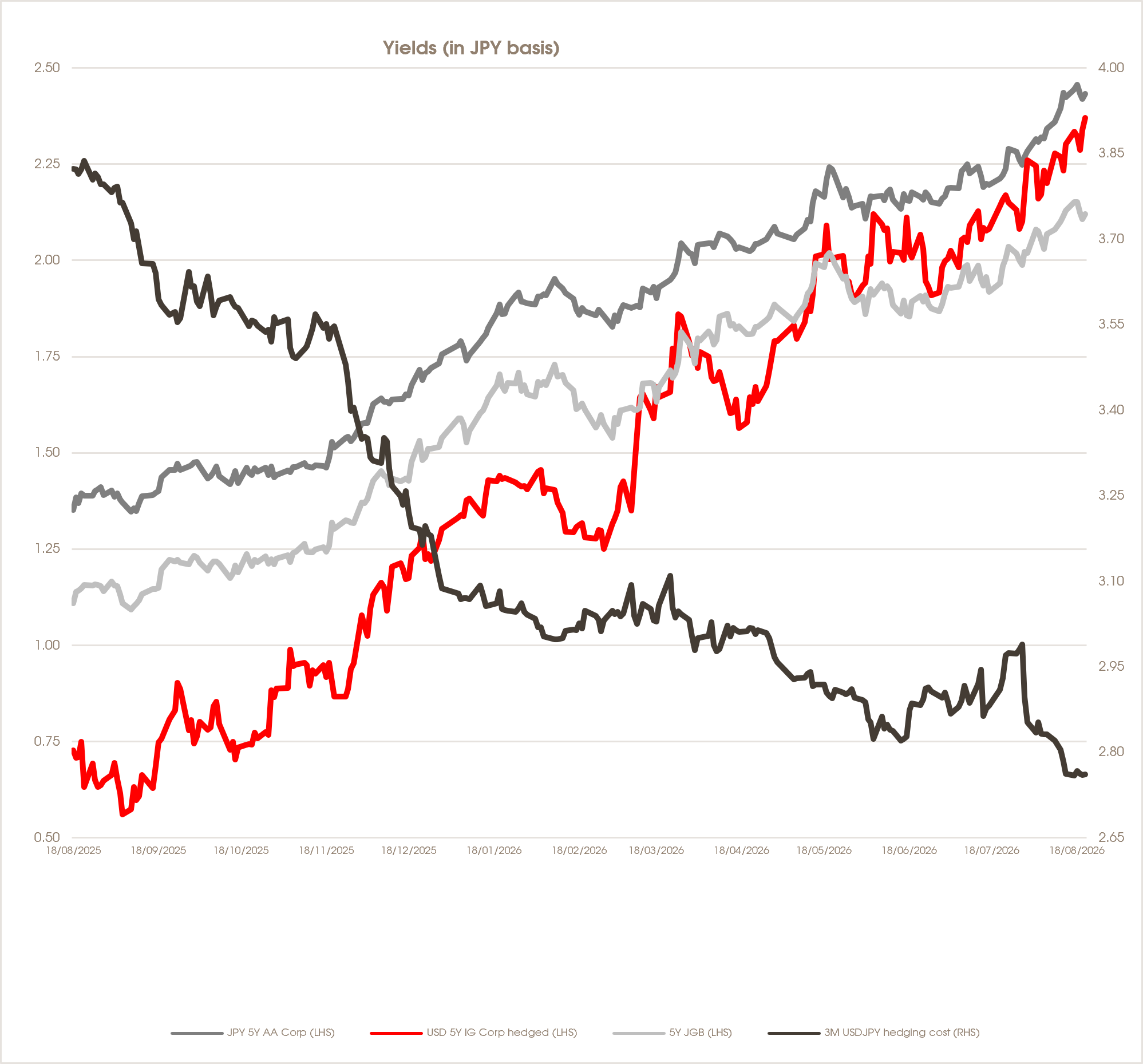
Another development worth monitoring is the evolving relative attractiveness of Japanese government bonds (JGBs) versus hedged USD fixed income assets. Japan remains one of the largest foreign holders of USTs, and any meaningful reallocation by major domestic institutional investors, including life insurers and the Government Pension Investment Fund (GPIF), could have significant implications for UST demand and long-end US yields.
From a fixed income perspective, the more critical consideration is the trajectory of Japanese interest rates. As JGB yields continue to rise and the yield differential between Japan and the US narrows, domestic investors may increasingly view local fixed income assets as a compelling alternative to hedged USD investments. Such shifts could gradually influence portfolio allocations among large institutional investors, potentially contributing to greater volatility across both the UST and US IG credit markets.
Japanese demand for USD IG credit is largely driven by relative yield opportunities after accounting for foreign exchange hedging costs. The recent decline in USD/JPY hedging costs has enhanced the attractiveness of hedged USD corporate bonds relative to JGBs and reduced the yield advantage previously enjoyed by domestic corporate bonds, as illustrated below.
Overall, the relative appeal of USD and JPY-denominated credit remains highly dynamic. Future allocation decisions will depend on a combination of factors, including Bank of Japan (BoJ) and Fed policy trajectories, interest rate differentials, FX hedging costs, exchange rate movements, and broader economic and political developments.
Exhibit 6: JPY hedged yield comparison
Source: Bloomberg as of 21 Aug 2026
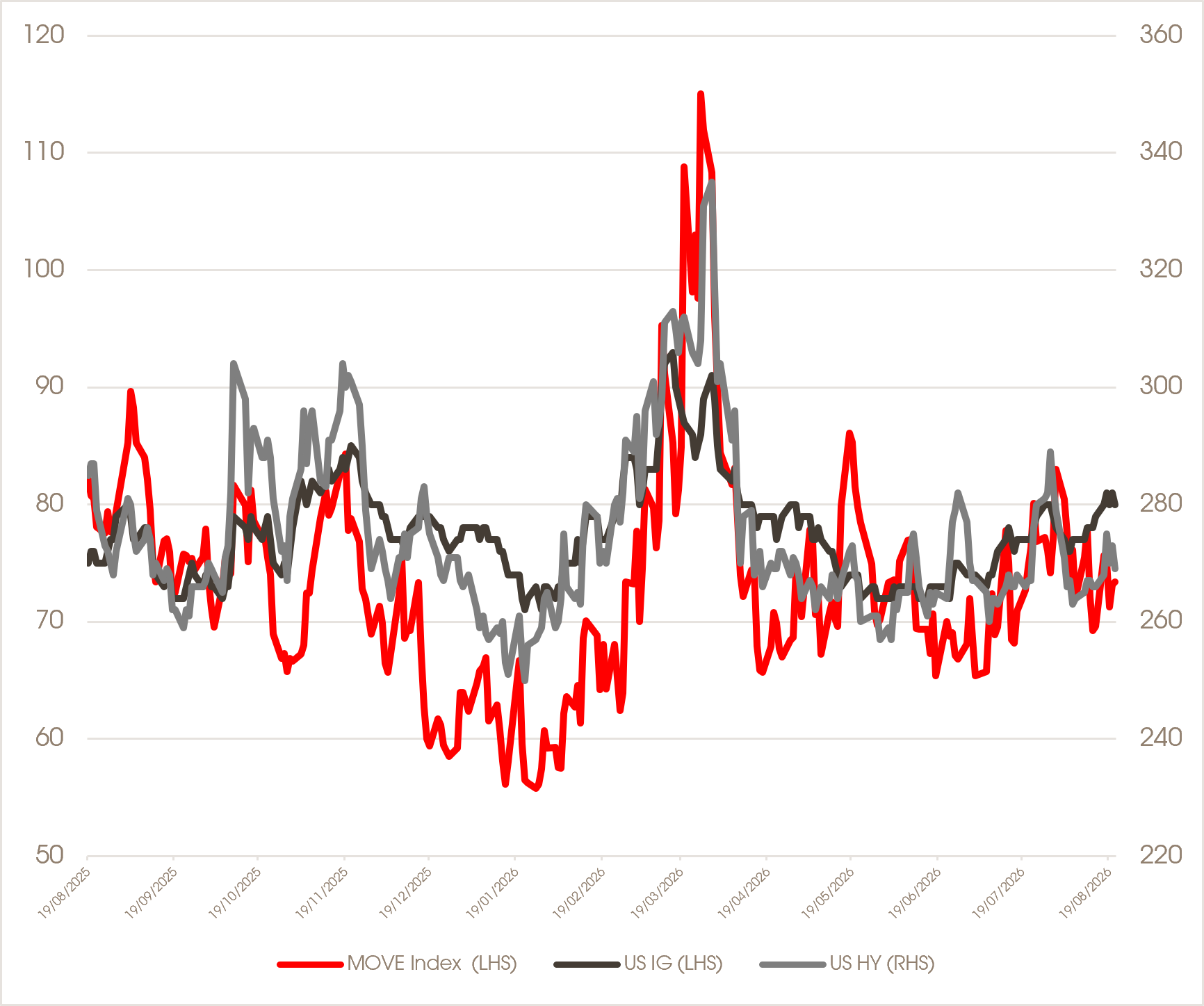
For credit investors, the key risk remains rates volatility. Historically, periods of sharply rising rates volatility have been associated with wider credit spreads. While spreads have remained resilient thus far, a sustained increase in volatility could eventually trigger spread widening.
Exhibit 7: Rates volatility vs US credit spreads
Source: Bloomberg as of 21 Aug 2026
At the same time, the carry profile IG credit remains compelling. The total return breakeven for US IG bonds has risen to approximately 84bps, meaning yields would need to increase substantially, by 84bps to roughly 6.3%, before investors begin to experience negative total returns over the coming year. This continues to provide a strong technical underpinning for the asset class.
That said, while the carry cushion is healthy, the spread-only breakeven of 12bps remains near its historical lows, underscoring that current IG spreads at 80bps provides minimal protection against any spread widening episode.
The two metrics tell a consistent story: US IG is well-insulated against rate moves but highly vulnerable to spread widening, all else equal.
From a policy perspective, the US Treasury could potentially support long-end bonds by adjusting the duration profile of issuance or by further expanding its buyback programme. However, such measures are unlikely to materially alter the longer-term direction of yields. More durable downward pressure on long-end rates would likely require structural changes, including meaningful fiscal consolidation, a sustained decline in inflation, or slower economic growth.
In our view, the market's focus on US Treasury issuance alone overlooks another important driver of higher long-end yields: the significant surge in capital demands associated with the AI investment cycle. Hyperscaler CAPEX, data-centre construction and power infrastructure investment are creating sustained demand for capital on a scale not seen in decades. In effect, markets are increasingly pricing in a world where capital is more constrained and therefore commands a higher cost.
Viewed through this lens, the rise in long-end yields reflects not only growing government borrowing requirements, but also expectations of persistently strong capital demand from the private sector. If investors continue to believe that large structural fiscal deficits will coexist with elevated inflation and higher real rates, they are likely to demand greater compensation for owning long-duration assets.
Given the continued uncertainty surrounding Fed policy, inflation dynamics, fiscal developments and long-end rate behaviour, we maintain a Neutral duration stance at the portfolio level. While our strategic preference remains for portfolios to operate within a 3-7Y duration range, we currently favour positioning closer to the midpoint of our asset allocation framework over the next few months (i.e. approximately five years), rather than extending duration risk aggressively.
This balanced stance provides flexibility across a range of potential outcomes. A deterioration in economic growth or downside surprises in inflation could support extending duration exposure, while persistently sticky inflation, renewed fiscal concerns or higher term premia would argue for maintaining a shorter-duration posture.
Looking ahead, market attention will be firmly focused on Kevin Warsh's speech at Jackson Hole on 28 August 2026, as well as any announcements from US Treasury Secretary Scott Bessent regarding fiscal consolidation measures. Both events could provide important signals for the outlook for rates, UST supply, and broader risk markets heading into the final months of the year.
Disclaimers and Disclosures
This material is prepared by Bank of Singapore Limited (Co Reg. No.: 197700866R) (the “Bank”) and is distributed in Singapore by the Bank.
This material does not provide individually tailored investment advice. This material has been prepared for and is intended for general circulation. The contents of this material does not take into account the specific investment objectives, investment experience, financial situation, or particular needs of any particular person. You should independently evaluate the contents of this material, and consider the suitability of any product discussed in this material, taking into account your own specific investment objectives, investment experience, financial situation and particular needs. If in doubt about the contents of this material or the suitability of any product discussed in this material, you should obtain independent financial advice from your own financial or other professional advisers, taking into account your specific investment objectives, investment experience, financial situation and particular needs, before making a commitment to purchase any product.
The Bank shall not be responsible or liable for any loss (whether direct, indirect or consequential) that may arise from, or in connection with, any use of or reliance on any information contained in or derived from this material, or any omission from this material, other than where such loss is caused solely by the Bank’s wilful default or gross negligence.
This material is not and should not be construed, by itself, as an offer or a solicitation to deal in any product or to enter into any legal relations. You should contact your own licensed representative directly if you are interested in buying or selling any product discussed in this material.
This material is not intended for distribution, publication or use by any person in any jurisdiction outside Singapore, Hong Kong or such other jurisdiction as the Bank may determine in its absolute discretion, where such distribution, publication or use would be contrary to applicable law or would subject the Bank or its related corporations, connected persons, associated persons or affiliates (collectively “Affiliates”) to any licensing, registration or other requirements in such jurisdiction.
The Bank and its Affiliates may have issued other reports, analyses, or other documents expressing views different from the contents of this material, and may provide other recommendations or make investment decisions that are contrary to the views expressed in this material, and all views expressed in all reports, analyses and documents are subject to change without notice. The Bank and its Affiliates reserve the right to act upon or use the contents of this material at any time, including before its publication.
The author of this material may have discussed the information or views contained in this material with others within or outside the Bank, and the author or such other Bank employees may have already acted on the basis of such information or views (including communicating such information or views to other customers of the Bank).
The Bank, its employees (including those with whom the author may have consulted in the preparation of this material))and discretionary accounts managed by the Bank may have long or short positions (including positions that may be different from or opposing to the views in this material or may be otherwise interested in any of the product(s) (including derivatives thereof) discussed in material, may have acquired such positions at prices and market conditions that are no longer available, may from time to time deal in such product(s) and may have interests different from or adverse to your interests.
Analyst Declaration
The analyst(s) who prepared this material certifies that the opinions contained herein accurately and exclusively reflect his or her views about the securities of the company(ies) and that he or she has taken reasonable care to maintain independence and objectivity in respect of the opinions herein.
The analyst(s) who prepared this material and his/her associates do not have financial interests in the company(ies). Financial interests refer to investments in securities, warrants and/or other derivatives. The analyst(s) receives compensation based on the overall revenues of Bank of Singapore Limited, and no part of his or her compensation was, is, or will be directly or indirectly related to the inclusion of specific recommendations or views in this material. The reporting line of the analyst(s) is separate from and independent of the business solicitation or marketing departments of Bank of Singapore Limited.
The analyst(s) and his/her associates confirm that they do not serve as directors or officers of the company(ies) and the company(ies)or other third parties have not provided or agreed to provide any compensation or other benefits to the analyst(s) in connection with this material.
An “associate” is defined as (i) the spouse, parent or step-parent, or any minor child (natural or adopted) or minor step-child, or any sibling or step-sibling of the analyst; (ii) the trustee of a trust of which the analyst, his spouse, parent or step-parent, minor child (natural or adopted) or minor step-child, or sibling or step-sibling is a beneficiary or discretionary object; or (iii) another person accustomed or obliged to act in accordance with the directions or instructions of the analyst.
Conflict of Interest Declaration
The Bank is a licensed bank regulated by the Monetary Authority of Singapore in Singapore. Bank of Singapore Limited, Hong Kong Branch (incorporated in Singapore with limited liability), is an Authorized Institution as defined in the Banking Ordinance of Hong Kong (Cap 155), regulated by the Hong Kong Monetary Authority in Hong Kong and a Registered Institution as defined in the Securities and Futures Ordinance of Hong Kong (Cap.571) regulated by the Securities and Futures Commission in Hong Kong. The Bank, its employees and discretionary accounts managed by its Singapore Office/Hong Kong Office may have long or short positions or may be otherwise interested in any of the investment products (including derivatives thereof) referred to in this document and may from time to time dispose of any such investment products. The Bank forms part of the OCBC Group (being for this purpose Oversea-Chinese Banking Corporation Limited (“OCBC Bank”) and its subsidiaries, related and affiliated companies). OCBC Group, their respective directors and/or employees (collectively “Related Persons”) may have interests in the investment products or the issuers mentioned herein. Such interests include effecting transactions in such investment products, and providing broking, investment banking and other financial services to such issuers. OCBC Group and its Related Persons may also be related to, and receive fees from, providers of such investment products. There may be conflicts of interest between OCBC Bank, the Bank, OCBC Investment Research Private Limited, OCBC Securities Private Limited or other members of the OCBC Group and any of the persons or entities mentioned in this report of which the Bank and its analyst(s) are not aware due to OCBC Bank’s Chinese Wall arrangement.
The Bank adheres to a group policy (as revised and updated from time to time) that provides how entities in the OCBC Group manage or eliminate any actual or potential conflicts of interest which may impact the impartiality of research reports issued by any research analyst in the OCBC Group.
Other Disclosures
Dubai International Financial Center (DIFC)
Where this material relates to structured products and bonds, this clause applies:
The Distributor represents and agrees that it has not offered and will not offer the product to any person in the Dubai International Financial Centre unless such offer is an “Exempt Offer” in accordance with the Market Rules of the Dubai Financial Services Authority (the “DFSA”).
The DFSA has no responsibility for reviewing or verifying any documents in connection with Exempt Offers.
The DFSA has not approved the Information Memorandum or taken steps to verify the information set out in it, and has no responsibility for it.
The product to which this document relates may be illiquid and/or subject to restrictions in respect of their resale. Prospective purchasers of the products offered should conduct their own due diligence on the products.
Please make sure that you understand the contents of the relevant offering documents (including but not limited to the Information Memorandum or Offering Circular) and the terms set out in this document. If you do not understand the contents of the relevant offering documents and the terms set out in this document, you should consult an authorised financial adviser as you deem necessary, before you decide whether or not to invest.
Where this material relates to a fund, this clause applies:
This Fund is not subject to any form of regulation or approval by the Dubai Financial Services Authority (“DFSA”). The DFSA has no responsibility for reviewing or verifying any Prospectus or other documents in connection with this Fund. Accordingly, the DFSA has not approved the Prospectus or any other associated documents nor taken any steps to verify the information set out in the Prospectus, and has no responsibility for it. The Units to which this Fund relates may be illiquid and/or subject to restrictions on their resale. Prospective purchasers should conduct their own due diligence on the Units. If you do not understand the contents of this document you should consult an authorized financial adviser. Please note that this offer is intended for only Professional Clients and is not directed at Retail Clients.
These are also available for inspection, during normal business hours, at the following location:
Bank of Singapore
Office 30-34 Level 28
Central Park Tower
DIFC, Dubai
U.A.E
Hong Kong
Bank of Singapore Limited (Hong Kong Branch) is an Authorized Institution as defined in the Banking Ordinance of Hong Kong (Cap 155), regulated by the Hong Kong Monetary Authority in Hong Kong and a Registered Institution as defined in the Securities and Futures Ordinance of Hong Kong (Cap.571). Financial products and services are only offered to “Professional Investors" within the meaning of the Securities and Futures Ordinance and the Securities and Futures (Professional Investor) Rules made thereunder.
This material has not been delivered for registration to the Registrar of Companies in Hong Kong and its contents have not been reviewed by any regulatory authority in Hong Kong. Accordingly: (i) the investment product may not be offered or sold in Hong Kong by means of any document other than to persons who are "Professional Investors" within the meaning of the Securities and Futures Ordinance (Cap. 571) of Hong Kong and the Securities and Futures (Professional Investor) Rules made thereunder or in other circumstances which do not result in the document being a "prospectus" within the meaning of the Companies (Winding Up and Miscellaneous Provisions) Ordinance (Cap. 32) of Hong Kong or which do not constitute an offer to the public within the meaning of the Companies (Winding Up and Miscellaneous Provisions) Ordinance; and (ii) no person may issue any invitation, advertisement or other material relating to the investment product whether in Hong Kong or elsewhere, which is directed at, or the contents of which are likely to be accessed or read by, the public in Hong Kong (except if permitted to do so under the securities laws of Hong Kong) other than with respect to the investment product which is or is intended to be disposed of only to persons outside Hong Kong or only to "Professional Investors" within the meaning of the Securities and Futures Ordinance and the Securities and Futures (Professional Investor) Rules made thereunder.
Where this material involves derivatives, do not invest in it unless you fully understand and are willing to assume the risks associated with it. If you have any doubt, you should seek independent professional financial, tax and/or legal advice as you deem necessary.
Where this material relates to a Complex Product, this clause applies:
Warning Statement and Information about Complex Product
(Applicable to accounts managed by Hong Kong Relationship Managers)
Where this material relates to a Complex Product (funds and ETFs), this clause applies additionally:
Where this material relates to a Complex Product (Options and its variants, Swap and its variants, Accumulator and its variants, Reverse Accumulator and its variants, Forwards), this clause applies additionally:
Where this material relates to a Loss Absorption Product, this clause applies:
Warning Statement and Information about Loss Absorption Products
(Applicable to accounts managed by Hong Kong Relationship Managers)
Before you invest in any Loss Absorption Product (as defined by the Hong Kong Monetary Authority), please read and ensure that you understand the features of a Loss Absorption Product, which may generally have the following features:
Where this material relates to a certificate of deposit, this clause applies:
A certificate of deposit is not a protected deposit and is not protected by the Deposit Protection Scheme in Hong Kong.
Where this material relates to a structured deposit, this clause applies:
A structured deposit is not a protected deposit and is not protected by the Deposit Protection Scheme in Hong Kong.
Where this material relates to a structured product, this clause applies:
This is a structured product which involves derivatives. Do not invest in it unless you fully understand and are willing to assume the risks associated with it. If you are in any doubt about the risks involved in the product, you may clarify with the intermediary or seek independent professional advice.
Singapore
Bank of Singapore Limited is a bank licensed and regulated by the Monetary Authority of Singapore. The Bank is also an Exempt Capital Markets Services Entity under the Securities and Futures Act 2001 and an Exempt Financial Adviser under the Financial Advisers Act 2001.
Where this material relates to structured deposits, this clause applies:
The product is a structured deposit. Structured deposits are not insured by the Singapore Deposit Insurance Corporation. Unlike traditional deposits, structured deposits have an investment element and returns may vary. You may wish to seek independent advice from a financial adviser before making a commitment to purchase this product. In the event that you choose not to seek independent advice from a financial adviser, you should carefully consider whether this product is suitable for you.
Where this material relates to dual currency investments, this clause applies:
The product is a dual currency investment. A dual currency investment product (“DCI”) is a derivative product or structured product with derivatives embedded in it. A DCI involves a currency option which confers on the deposit-taking institution the right to repay the principal sum at maturity in either the base or alternate currency. Part or all of the interest earned on this investment represents the premium on this option.
By purchasing this DCI, you are giving the issuer of this product the right to repay you at a future date in an alternate currency that is different from the currency in which your initial investment was made, regardless of whether you wish to be repaid in this currency at that time. DCIs are subject to foreign exchange fluctuations which may affect the return of your investment. Exchange controls may also be applicable to the currencies your investment is linked to. You may incur a loss on your principal sum in comparison with the base amount initially invested. You may wish to seek advice from a financial adviser before making a commitment to purchase this product. In the event that you choose not to seek advice from a financial adviser, you should carefully consider whether this product is suitable for you.
United Kingdom
Bank of Singapore Limited, UK Branch (BOSL UK) is incorporated and registered in Singapore with the Accounting and Corporate Regulatory Authority (Registration no.:197700866R) as a public company limited by shares with head office in Singapore and operating in the UK through its UK establishment (BR027666). Bank of Singapore Limited, UK branch (FRN: 1038970) is an appointed representative of Oversea-Chinese Banking Corporation Limited, London branch. Oversea-Chinese Banking Corporation Limited (OCBC) is authorised and regulated by the Monetary Authority of Singapore. OCBC London Branch is authorised by the Prudential Regulation Authority with firm reference number 204687 and subject to regulation by the Financial Conduct Authority and limited regulation by the Prudential Regulation Authority. Details about the extent of OCBC London Branch’s regulation by the Prudential Regulation Authority are available on request. This material is intended solely for the use of the designated recipients. Unauthorised access, use, or distribution is strictly prohibited. If you are not the intended recipient, please notify us immediately and erase all copies. Bank of Singapore Limited, UK Branch does not provide legal, accounting or tax advice. Please consult an independent professional for advice tailored to your specific situation.
This product or service is offered exclusively for investors eligible for categorisation as a professional client. This is not intended for retail clients. Any person in the UK who receives this material is deemed to have represented and agreed that they qualify as a Professional Client. Such recipients also represent and agree that they have not received this material on behalf of any persons in the UK other than Professional Clients for whom they have authority to make investment decisions on a wholly discretionary basis. BOSL UK will rely on the truth and accuracy of these representations and agreements. Any person who is not a Professional Client should neither act on nor rely upon this material or any of its contents.
Investing in financial markets carries the risk of losing capital, and investors should be aware of and carefully consider this risk before making any investment decisions. The value of investments can fluctuate, and there is no guarantee that investors will recoup their initial investment. Past performance is not indicative of future results, and the performance of investments can be affected by various factors, including but not limited to market conditions, economic factors, and changes in regulations or tax laws. Forward-looking statements should not be considered as guarantees or predictions of future events. Investors should be prepared for the possibility of losing all or a portion of their invested capital. It is recommended that investors seek professional advice and conduct thorough research before making any investment decisions. BOSL UK does not endorse any specific investments or financial products mentioned in this material. Neither BOSL UK nor its employees accept any liability for any loss or damage arising from the use of this material or reliance on its content.
Cross Border Disclaimer and Disclosures
Refer to https://www.bankofsingapore.com/Disclaimers_and_Disclosures.html for cross-border marketing disclaimers and disclosures.
ESG Disclaimer
This document contains information on ESG factors or the Bank’s process for taking into consideration, and evaluation or assessment of ESG factors.
There are currently no universally accepted environmental, social and governance (“ESG”) standards, and no consensus as to whether activities and practices or products or services are “environmentally friendly”, “sustainable”, “responsible”, “climate friendly”, etc. Evaluation of ESG outcomes or metrics may require forward-looking scenario analysis, estimates, interpretations and assumptions and may be uncertain and speculative. There may not be scientific consensus. Scientific evidence and data may not be conclusive or there may be limitations, and new evidence and data may be emerging. ESG standards may depend on subjective or value judgments. ESG standards, as well as laws, rules and regulations may differ from jurisdiction to jurisdiction. Taxonomies have been developed in different jurisdictions to classify activities as “environmentally sustainable”, “green” or the equivalent, and different taxonomies may classify the same activity differently. Achieving one ESG goal may be at the expense of, or require a compromise on, other ESG goals. The Bank’s ESG standards and evaluation or assessment of ESG factors may therefore not meet your expectations or objectives and may not be consistent with certain ESG laws, rules, regulations and standards. There is no guarantee that there will not be negative ESG outcomes, and the Bank does not give any assurance that your investments will have a positive ESG impact. You should ensure that you understand the Bank’s ESG standards and process for evaluation or assessment of ESG factors, and assess whether the Bank’s ESG standards and process for evaluation or assessment of ESG factors meets your expectations or is appropriate for you, before making any investment commitment. You are solely responsible for your own investment decisions.
The Bank relies on third party ESG ratings. While the Bank has selected its third party ESG rating providers in good faith and with reasonable care, the Bank has not independently verified the ESG ratings of third party providers. The Bank gives no representation or warranty, express or implied, as to the quality, accuracy, completeness, rigour, timeliness or verifiability of such third party ESG ratings, and shall not be responsible or liable for such third party ESG ratings. ESG ratings may be based on data that is incomplete, due to limitations or otherwise, or based on commitments and targets which may not be achieved. You should review and understand the disclosures made by such third party ESG ratings providers on their methodologies, data sources and other relevant information, and obtain advice from professional advisers as necessary.
Taking into consideration ESG factors may be at the expense of higher financial returns, especially in the short term. Although ESG risks may result in financial losses, such losses may, and if at all, only materialise in the long term. ESG factors and screening may also result in certain investments that deliver high financial returns being excluded, or limit the diversity of investments, which could in turn affect the volatility of portfolios.